
HOA Construction Project Management: A Board’s Guide to Fiduciary Oversight
Updated: 2 days ago
Can a volunteer board realistically maintain control over a multi-million dollar remediation project when the interests of contractors and the association are fundamentally misaligned? For many directors, the weight of fiduciary responsibility becomes a source of profound anxiety as they face complex capital expenditure decisions without a technical background. It's understandable to feel overwhelmed by the prospect of unexpected special assessments or legal disputes. This guide provides a professional framework for HOA construction project management designed to protect your community's interests through every phase of the development lifecycle. By adopting an "Owners First" hands-on approach, you can bridge the gap between initial design inception and final project closeout with total confidence. We will examine the essential project controls and independent oversight strategies required to ensure your high-stakes projects remain on schedule, within budget, and fully transparent for every homeowner. This methodical approach transforms construction from a liability into a strategic investment in your property's long-term value.
Table of Contents
Navigating the Complexity of HOA and Condo Construction Projects
Effective HOA construction project management represents a specialized exercise of fiduciary oversight rather than a mere administrative task. Community association boards are legally tasked with protecting and enhancing the collective assets of their members. This responsibility scales significantly as projects evolve from routine maintenance into multi-million dollar capital expenditure (CapX) initiatives. When high-stakes remediation or structural repairs are required, the inherent conflict of interest between contractors, who prioritize profit margins, and the association, which requires quality and cost control, becomes a critical vulnerability for the board. Volunteer directors must prioritize independent advocacy to ensure that their fiduciary obligations are met without exposing the community to unnecessary financial strain.
The Risk of Generalist Oversight
Property managers are indispensable for daily operations, yet they typically lack the technical engineering or construction expertise required to manage complex risk. Relying on generalist oversight for large-scale works often leads to inadequate project scoping and poor financial accountability. Without professional guidance, associations face severe legal and financial consequences, including construction defects and unmanaged cost overruns that necessitate painful special assessments. Meticulous attention to detail during the bidding and contract phase is essential to mitigate these risks before the first shovel hits the ground.
Fiduciary Duty and Capital Improvements
A board’s primary obligation is the preservation of property values through proactive stewardship of the physical plant. Maintaining this standard during major remediation requires a level of technical and financial oversight that exceeds the capacity of most volunteer directors. An Owner’s Representative serves as the board’s dedicated technical and financial safeguard, ensuring every decision aligns with the association’s long-term interests rather than the contractor’s bottom line. Professional HOA construction project management ensures that complex remediation projects don't compromise the association’s financial stability or the safety of its residents through every phase of the project lifecycle.
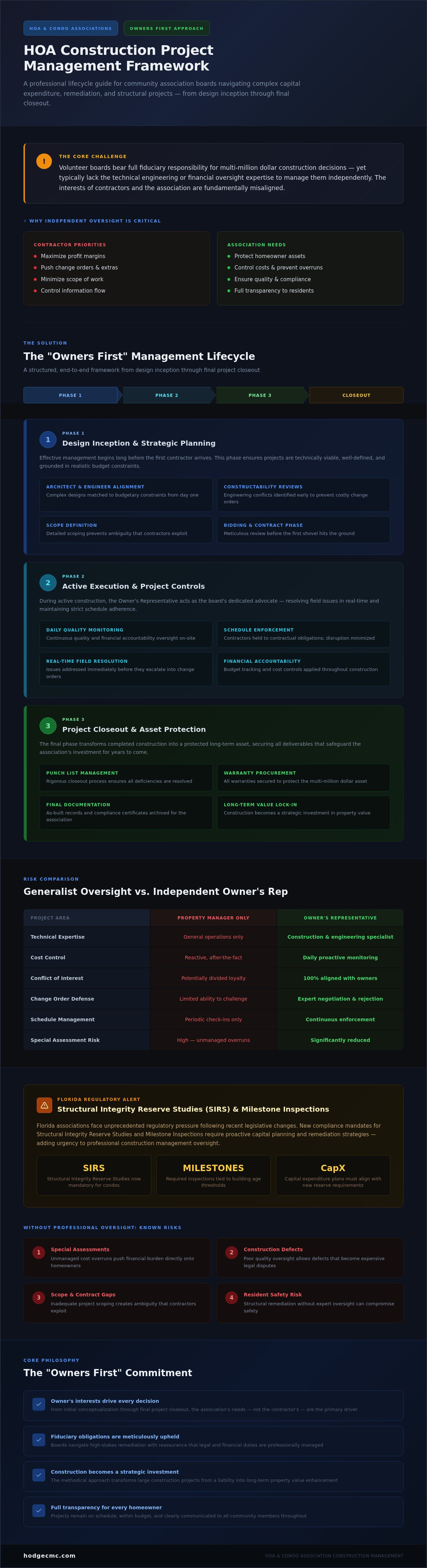
The "Owners First" Management Lifecycle: From Inception to Closeout
Successful HOA construction project management requires a methodical, end-to-end framework that extends far beyond simple site visits. Hodge Construction Management & Consulting's "Owners First" hands-on approach serves as the gold standard for community associations, ensuring professional oversight through every development milestone. This philosophy dictates that the owner's interests remain the primary driver of every decision, from initial conceptualization to the final project closeout. By implementing a structured lifecycle, boards can navigate high-stakes remediation with the reassurance that their fiduciary duties are being meticulously upheld. It's about building certainty.
Phase 1: Design Inception and Strategic Planning
Effective management begins long before the first contractor arrives on site. During design inception, we provide strategic advice to ensure that every project is technically viable and well-defined. We collaborate with architects and engineers to align complex designs with the association’s specific budgetary constraints. This phase includes intensive constructability reviews. These reviews allow us to identify potential engineering conflicts early, preventing expensive change orders and ensuring the project remains grounded in reality.
Phase 2: Execution and Project Controls
During the active construction phase, HCMC acts as the board’s dedicated advocate to resolve field issues in real-time. We maintain strict adherence to the project schedule to minimize community disruption and ensure contractors meet their contractual obligations. Our specialized Construction Management Owner's Representative services provide the project controls necessary to monitor quality and financial accountability daily. Once the physical work is complete, we manage the rigorous closeout process, finalizing punch lists and securing all warranties to protect the association’s multi-million dollar asset for years to come. This comprehensive approach defines elite HOA construction project management.
Mitigating Risk in Florida Capital Expenditure and Remediation
Florida associations face unprecedented regulatory pressure following recent legislative changes. The introduction of Structural Integrity Reserve Studies (SIRS) and mandatory Milestone Inspections has compressed the timeline for high-stakes remediation. Boards must now coordinate technical repairs with long-term financial planning to meet strict state-mandated deadlines, including the 2026 Milestone Inspection requirements for many coastal properties. Professional HOA construction project management becomes essential here to ensure these mandated projects don't lead to financial insolvency or legal non-compliance.
Navigating SIRS and Milestone Requirements
Managing the construction implications of Florida’s evolving safety statutes requires more than just a reserve study update. It demands a proactive strategy to execute remediation that satisfies structural engineers while remaining fiscally responsible. We help boards prioritize life-safety repairs and integrate them into a comprehensive capital expenditure roadmap. This ensures the association meets its legal obligations without unnecessary community disruption or unmanaged financial exposure.
The Bidding and Contractor Vetting Process
Financial accountability begins with crafting precise RFPs that force contractors to provide transparent, "apples-to-apples" pricing. Without a standardized bid package, boards often receive incomparable proposals that hide potential change orders. HCMC identifies red flags by performing granular forensic reviews of bid documents to reveal hidden exclusions or unrealistic unit pricing that typically leads to mid-project cost escalations. Utilizing expert Construction Consulting and HOA construction project management ensures the association selects partners based on technical merit and historical performance rather than just the lowest initial price. This methodical vetting prevents conflicts from escalating into costly litigation, protecting the board's fiduciary standing through every phase of the work.
The Value of Independent Owner’s Representation for Associations
The return on investment for independent owner’s representation is realized through the mitigation of catastrophic financial risk and the preservation of long-term property values. Engaging a professional for HOA construction project management ensures that a board’s fiduciary oversight is reinforced by technical expertise rather than contractor-driven agendas. HCMC provides the reassurance and reliability necessary to guide associations through high-stakes environments, acting as a dedicated shield against operational inefficiency. Our advocacy is absolute. Our interests are inextricably linked to the owners, distinguishing our role from that of contractors or design consultants who may have conflicting priorities. It's about building certainty.
Protecting the Owners Interests
HCMC’s "Owners First" methodology is built on a foundation of ethical standards and operational excellence. We provide the methodical project controls required to ensure that every phase of the construction lifecycle meets the highest quality benchmarks. This commitment is supported by extensive third-party validation from industry leaders, which serves to build unwavering board confidence. By maintaining a disciplined, process-driven approach, we transform complex remediation into a predictable and manageable outcome for the community.
Next Steps for Your Association
Preparing for significant capital expenditure or structural remediation requires strategic foresight and a seasoned veteran at the helm. Associations should view professional HOA construction project management as the essential foundation for long-term community success rather than a discretionary expense. To initiate a comprehensive consultation for your upcoming CapX or remediation projects, contact our team to discuss your specific requirements. We're prepared to assist your board in navigating the next phase of community maintenance with the precision and integrity your residents deserve.
Securing the Future of Your Community Association Assets
Effective stewardship of a community's physical and financial health requires more than just reactive maintenance. Professional HOA construction project management serves as the essential bridge between volunteer boards and the technical complexities of large scale remediation. By prioritizing independent advocacy and a comprehensive lifecycle approach, associations can navigate the stringent requirements of Florida's Milestone Inspections and SIRS with absolute certainty. This "Owners First" methodology ensures that every dollar invested is protected through rigorous project controls and meticulous oversight from design inception to final closeout. Our team brings decades of high level experience to your most challenging projects, acting as the steady hand you need in high stakes environments. Don't leave your community's most valuable assets to chance or unmanaged contractor interests. You can consult with HCMC on your association’s next project to establish a foundation of operational excellence and ethical standards. Taking this proactive step today ensures a resilient and financially stable future for every homeowner you represent.
Frequently Asked Questions
Why can’t our property manager handle construction project management?
Property managers are essential for daily community operations, but they rarely possess the technical engineering or specialized training required to oversee complex remediation. Managing multi-million dollar capital projects involves technical risk assessment and financial oversight that fall outside the typical scope of property management licensure. Entrusting these high-stakes tasks to generalists exposes the board to significant liability and potential construction defects that property managers aren't equipped to identify or mitigate.
What is the difference between an Owner’s Representative and a General Contractor?
An Owner’s Representative serves as the association’s dedicated advocate, while a General Contractor is the entity performing the physical work. The contractor’s primary motivation is profit, which often conflicts with the association’s need for quality and cost control. In contrast, the representative maintains no financial interest in the construction labor or materials. This independence allows for unbiased oversight and ensures the board’s interests remain the primary driver of every project decision.
How does an Owner’s Rep help an HOA stay within budget?
A representative ensures financial accountability by crafting standardized "apples-to-apples" bid packages that prevent hidden costs. This professional HOA construction project management includes rigorous forensic reviews of contractor proposals to identify unrealistic unit pricing or exclusions. By managing change orders and verifying that work is complete before releasing payments, the representative prevents the mid-project cost escalations that typically lead to painful special assessments for homeowners.
What Florida-specific regulations affect our construction project management?
Florida associations must adhere to the Structural Integrity Reserve Studies (SIRS) and mandatory Milestone Inspection statutes. These regulations impose strict deadlines for structural assessments and remediation, particularly for buildings three stories or higher. Navigating these requirements demands a proactive strategy to coordinate technical repairs with long-term financial planning. Expert oversight ensures the association meets its legal obligations by 2026 without compromising the community’s fiscal stability or resident safety.
At what stage should an HOA hire a construction management consultant?
Engaging a consultant during the design inception phase provides the greatest value to the association. Early involvement allows for comprehensive constructability reviews and strategic planning before contractors are even selected. This proactive approach to HOA construction project management identifies potential engineering conflicts and defines a realistic project scope from the start. Waiting until construction begins often results in reactive decision-making and expensive change orders that could have been avoided.


Comments