
Strategic Commercial Construction Consulting for Florida Community Associations
For a Florida community association board, approving a major remediation or capital expenditure project is one of the most consequential decisions you will ever make on behalf of your owners. The technical complexity is daunting, the financial exposure is real, and the risk of a poorly managed project landing squarely on residents through a special assessment is not hypothetical. It happens. And when it does, the board bears the weight of that outcome.
You already know the stakes. Construction advisory services for Florida HOAs and condo associations exist precisely because boards shouldn't have to face contractors, engineers, and regulatory requirements without a dedicated advocate in their corner. Someone whose loyalty is to the owners, not to the project's other stakeholders.
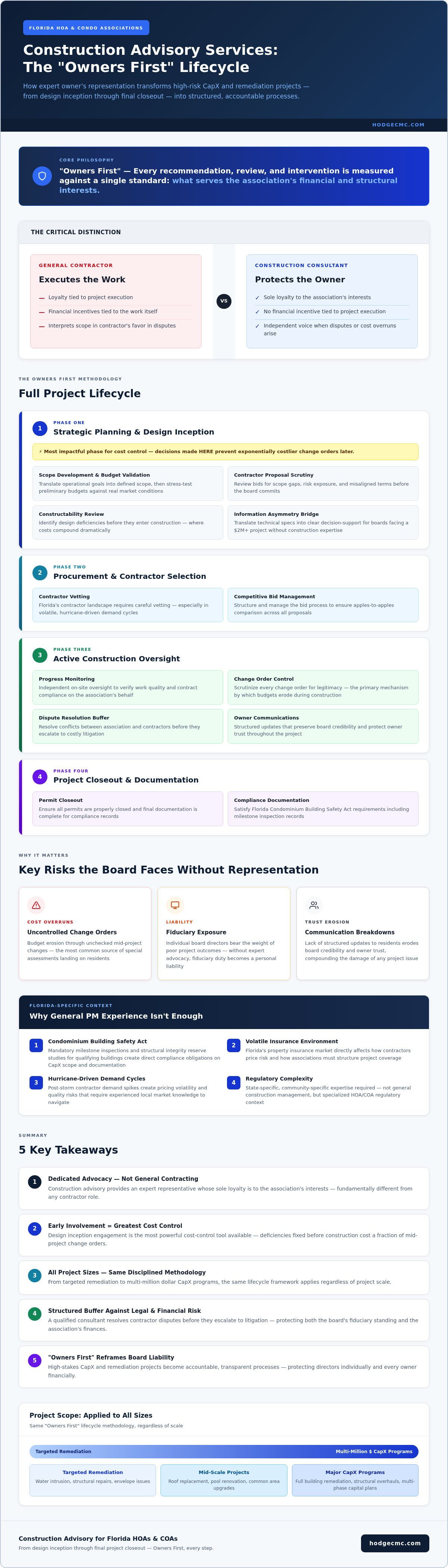
This article details how a specialized, "Owners First" approach to construction consulting transforms high-risk CapX and remediation projects from sources of board anxiety into structured, accountable processes. You'll see exactly how expert owner's representation works across the full project lifecycle, from design inception through final closeout, and why that comprehensive advocacy is the most reliable protection against cost overruns, liability exposure, and the communication breakdowns that erode owner trust.
Table of Contents
What is Commercial Construction Consulting for Community Associations?
Commercial construction consulting, at its core, is the practice of providing strategic oversight, technical advocacy, and structured project governance on behalf of a project owner. For a community association, that owner is the board, acting in a fiduciary capacity for every resident in the community. The consultant's function is fundamentally distinct from that of a general contractor: where a contractor is responsible for executing the work, a construction consultant is responsible for protecting the interests of the entity paying for it. That distinction is not semantic. It defines where loyalty sits when disputes arise, when costs escalate, or when a contractor's interpretation of scope diverges from the board's expectations.
The Consultant as the Board's Dedicated Advocate
Most board members are not construction professionals. They're accountants, attorneys, retirees, and business owners who have accepted the responsibility of governing a community. When a $2 million remediation project lands in front of them, the information asymmetry between the board and the contractors presenting bids is significant. A construction consultant bridges that gap directly, translating technical specifications into clear decision-support information, scrutinizing contractor proposals for scope gaps and risk exposure, and providing the board with an independent voice that carries no financial incentive tied to the project's execution. This is the operational definition of Owners First: every recommendation, every review, and every intervention is measured against a single standard - what serves the association's financial and structural interests.
Why Florida Associations Require Specialized Expertise
Florida's regulatory environment places demands on community associations that have grown considerably more complex in recent years. The Condominium Building Safety Act introduced mandatory milestone inspection requirements and structural integrity reserve studies for qualifying buildings, creating compliance obligations that intersect directly with how capital expenditure and remediation projects must be scoped, funded, and documented. Beyond statute, Florida's construction market is shaped by a volatile insurance environment, hurricane-driven demand cycles, and a contractor landscape that requires careful vetting. Construction advisory services for Florida HOAs and condo associations must account for all of these variables simultaneously. General project management experience is not sufficient. The expertise required is state-specific, community-specific, and grounded in the precise regulatory context in which Florida boards operate.
The 'Owners First' Lifecycle: From Design Inception to Project Closeout
The difference between a well-managed capital project and a costly, contentious one is rarely determined during construction. It's determined in the weeks and months before a single contractor sets foot on the property. A comprehensive, lifecycle-based approach to owner's representation recognizes this reality and structures advocacy accordingly, from the earliest planning conversations through to the final permit closeout documentation.
Phase 1: Strategic Planning and Design Inception
Engaging construction advisory services for Florida HOAs at the design inception phase is among the most consequential decisions a board can make. Scope gaps, constructability problems, and budget misalignments that go undetected during design don't simply persist into construction; they compound. A change order issued mid-project to correct a design deficiency costs exponentially more than addressing that same deficiency during a pre-construction review.
At this phase, disciplined owner's representation encompasses several interconnected activities:
Scope development and budget validation: Translating the board's operational goals into a defined project scope, then stress-testing preliminary budgets against current market conditions and realistic contingency requirements.
Constructability review: Evaluating proposed design documents for practical execution risks before those documents become the basis of contractor bids.
Architect and engineer vetting: Assessing design professionals not only on credentials, but on their demonstrated understanding of community association environments and Florida's specific regulatory requirements.
This front-end investment in structured planning is where the Owners First philosophy delivers its most immediate and measurable returns.
Phase 2: Execution and Closeout Excellence
Active construction demands a different kind of discipline. Day-to-day oversight means managing the interface between contractors and the board with precision: reviewing pay applications against verified progress, tracking schedule adherence, documenting site conditions, and intercepting scope disputes before they escalate. The board shouldn't be receiving information filtered through a contractor's interests. It should be receiving independent, verified reporting from a representative whose accountability runs entirely in the other direction.
Closeout is where poorly managed projects reveal their true costs. Unresolved punch list items, incomplete permit closures, missing warranty documentation, and unaddressed lien releases are not administrative inconveniences; they're liabilities that can encumber the association for years. A rigorous closeout process ensures every deliverable is secured, every regulatory requirement is satisfied, and the board receives a complete, organized project record before the final payment is released.
Boards that want to understand what this full-lifecycle advocacy looks like in practice can connect with HCMC's owner's representative team to discuss their specific project requirements.
Managing Remediation and Capital Expenditure (CapX) Projects
Not every capital project begins with a clean slate and a board-approved budget line. Many of the most consequential projects facing Florida community associations begin with a structural engineer's report, a failed inspection, or a building envelope failure that can no longer be deferred. These are remediation scenarios, and they demand a fundamentally different management posture than a planned amenity upgrade or scheduled roof replacement.
Remediation is the process of correcting structural or safety deficiencies to bring a building into compliance with modern standards, and in Florida's aging high-rise and mid-rise condo inventory, it is an increasingly common reality rather than an exceptional circumstance.
Navigating Complex Remediation Projects
Structural concrete deterioration, spalling, post-tension cable failures, and compromised waterproofing systems are not abstract risks for Florida's coastal and older inland communities. They're active conditions that require phased, carefully sequenced remediation work executed within a populated, occupied building. The operational complexity of managing contractor access, noise and dust mitigation, elevator scheduling, and resident communication simultaneously is considerable. Construction advisory services for Florida HOAs address this complexity directly, coordinating the sequencing of remediation phases to minimize disruption while maintaining continuous oversight of contractor performance and safety compliance. Residents deserve transparency. Boards deserve verified progress reports, not contractor-authored summaries.
Budgeting and Controls for CapX Success
Budget creep is the defining financial risk of association capital projects. It rarely arrives as a single catastrophic change order; it accumulates through underdefined scope, inadequate contingency planning, unverified pay applications, and contractor substitutions that erode the original value proposition of the approved bid. When a project is funded through a special assessment or association loan, the stakes compound considerably. Every dollar spent carries a direct, traceable obligation to the owners who funded it.
Disciplined project controls are the structural answer to this risk. That means establishing a detailed cost baseline before work begins, implementing a formal change order review process, verifying that each pay application reflects actual installed work, and maintaining a documented audit trail that the board can present to owners with complete confidence. Construction advisory services for Florida HOAs that incorporate rigorous project controls transform CapX from a financial exposure into a defensible, fully documented expenditure of association funds.
Cost baseline establishment: Locking a verified budget before mobilization, with realistic contingency allocations based on project type and site conditions.
Change order governance: Evaluating every proposed scope change for legitimacy, pricing accuracy, and necessity before board approval is sought.
Pay application verification: Confirming that contractor billing reflects verified, completed work rather than projected or anticipated progress.
Owner-facing documentation: Maintaining a complete, organized financial record that demonstrates responsible stewardship of every dollar assessed or borrowed.
Boards managing remediation or CapX under financial pressure shouldn't be navigating contractor relationships and cost controls without dedicated expert support. Connect with HCMC's project controls team to discuss how structured owner's representation protects your association's budget and your board's fiduciary standing.
Mitigating Risk and Protecting the Board's Fiduciary Duty
A board's fiduciary obligation to its owners doesn't pause during a construction project. It intensifies. Every contract executed, every pay application approved, and every change order signed carries the weight of that legal and financial responsibility. Without independent expert oversight, boards are making those decisions in an information vacuum, relying on documentation produced by the same contractors who stand to benefit from its interpretation. That's not a defensible position, and it's not one any board should accept.
Construction advisory services for Florida HOAs address this exposure directly. An owner's representative provides the independent, third-party oversight that transforms a board's project decisions from reactive approvals into documented, defensible exercises of fiduciary judgment. When disputes arise between the association and its contractors, and on complex projects they inevitably do, having an expert advocate who has maintained a contemporaneous project record is the difference between a dispute resolved at the negotiating table and one resolved in court.
Financial Accountability and Transparency
Pay application review is one of the most consequential, and most frequently underestimated, functions of owner's representation. Contractors bill against scheduled values that don't always reflect actual installed work. An experienced construction consultant reviews each application against verified field progress, flags overbilling, and ensures that stored materials meet contractual requirements before payment is authorized. Change order governance follows the same discipline: every proposed scope change is evaluated for contractual legitimacy, pricing accuracy, and necessity before the board is asked to approve it. The result is a financial record that the board can present to owners with complete confidence, demonstrating that every dollar of assessed or borrowed funds was spent with precision and accountability.
The HCMC Advantage: Veteran Experience in Florida
HCMC's principal leadership brings a depth of field experience that defines how every engagement is structured and executed. That expertise isn't a background credential; it's the operational foundation of the firm's Owners First approach. A methodical, process-driven methodology reduces the inherent uncertainty of construction by replacing improvised decision-making with structured protocols at every project phase. Boards working with HCMC aren't navigating complex remediation or capital expenditure projects alone. They're engaging a dedicated advocate whose professional reputation is inseparable from the quality of the outcome delivered on their behalf.
Construction advisory services for Florida HOAs are most valuable when they're engaged before risk materializes, not after. Boards ready to approach their next project with structured, expert representation can connect with HCMC's team to discuss how the Owners First methodology applies to their specific project requirements.
Your Board Deserves a Dedicated Advocate on Every Project
High-stakes construction projects don't have to be sources of board anxiety, financial exposure, or owner conflict. What separates a well-governed capital project from a costly, contentious one is rarely luck; it's the presence of a dedicated expert whose accountability runs entirely to the association, not to the contractors executing the work.
Construction advisory services for Florida HOAs deliver exactly that: a structured, Owners First methodology applied from design inception through final closeout, by professionals with veteran experience in Florida's specific regulatory and construction environment. Every phase of the project lifecycle, from scope validation to pay application review to permit closeout, is managed with the precision your owners' investment demands.
Boards that engage expert representation before risk materializes are consistently better positioned to protect their fiduciary standing, control costs, and maintain owner trust throughout a project's full duration.
HCMC is a proud sponsor of Condo Craze & HOAs. For board education on when a project's complexity calls for independent oversight, read Do You Really Need an Owner’s Rep? Here’s Who Does (2025). This is educational background; association counsel should advise on current legal requirements.
If your association has a remediation or CapX project on the horizon, don't navigate it without a dedicated advocate in your corner. Schedule a consultation with HCMC to protect your association's interests and approach your next project with confidence.
Frequently Asked Questions About Construction Advisory Services for Florida HOAs
What is the difference between an owner's representative and a general contractor?
An owner's representative works exclusively for the association, with no financial stake in how the work is executed or what it costs. A general contractor is responsible for delivering the construction work, which means their interests and the board's interests can diverge the moment a scope dispute or cost overrun emerges. That distinction defines where loyalty sits when the project gets complicated.
In practical terms, an owner's representative reviews contractor proposals, scrutinizes pay applications, and governs change orders on the board's behalf. The contractor produces the work; the owner's representative protects the entity paying for it. Those are fundamentally different functions, and conflating them leaves the board without an independent voice at the table.
How does a construction consultant help an HOA board fulfill its fiduciary duty?
Fiduciary duty requires board members to make informed, defensible decisions with association funds. Without independent expert oversight, boards are approving contracts and pay applications based on documentation produced by the same parties who benefit from its interpretation. That's a structural vulnerability, not a defensible governance position.
Construction advisory services for Florida HOAs address this directly by providing verified, third-party reporting at every project phase. Every pay application is reviewed against confirmed field progress, every change order is evaluated for legitimacy before board approval is sought, and a documented audit trail is maintained throughout. The result is a project record the board can present to owners with complete confidence.
When is the best time to hire a consultant for a remediation project?
The best time is before the scope is finalized, ideally as soon as a structural engineer's report or inspection finding identifies the need for remediation work. Engaging a consultant at that early stage means scope gaps and budget misalignments get caught before they're embedded in contractor bids. Corrections made during planning cost a fraction of what the same corrections cost mid-construction.
Boards that wait until a contractor is already mobilized are limiting their own options. An owner's representative engaged at inception can shape the procurement process, vet contractors on the association's behalf, and establish a verified cost baseline before a single dollar is committed.
Can a construction consultant help with small-scale CapX projects, or only large ones?
Construction advisory services apply to projects of all scales. The same disciplined lifecycle methodology that governs a multi-million dollar structural remediation applies equally to a targeted pool deck resurfacing, a roofing replacement, or a mechanical systems upgrade. Scope gaps, unverified billing, and inadequate change order controls create financial exposure regardless of project size.
For smaller projects, the engagement is proportionally structured, but the core function doesn't change: the board deserves independent oversight and a verified financial record whether the project budget is $150,000 or $5 million. The Owners First principle isn't reserved for large-scale work; it's the standard applied across every engagement.
How do consulting services help in preventing special assessments for condo owners?
Special assessments most often result from budget creep, underdefined scope, and inadequate contingency planning, not from a single catastrophic event. When pay applications go unverified, change orders are approved without rigorous review, and project contingencies are set without reference to realistic market conditions, costs accumulate in ways that eventually exceed what reserves can absorb.
Structured owner's representation addresses each of those failure points directly. A verified cost baseline, disciplined change order governance, and independent pay application review collectively reduce the financial drift that forces boards to return to owners for additional funds. Protecting the budget from the outset is the most reliable way to protect owners from the financial consequences of a project that ran beyond its means.
Comments